





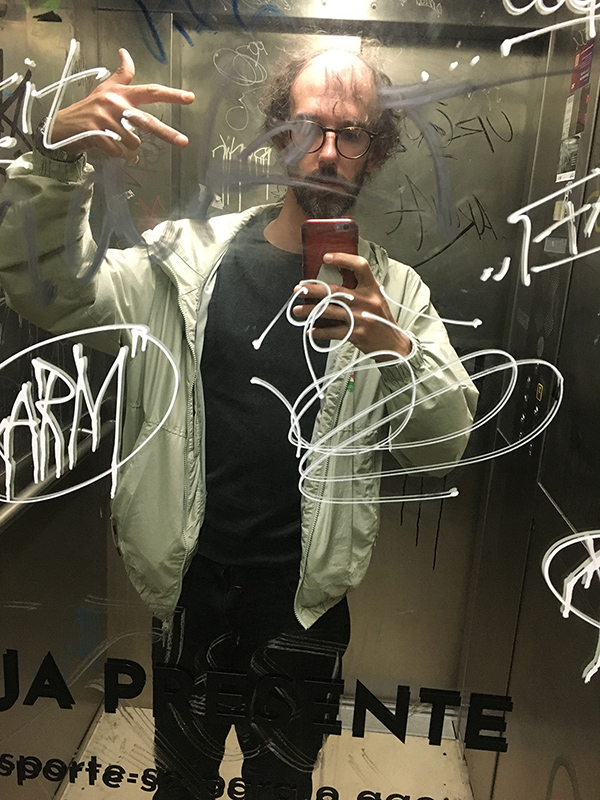
 There is coming out of the closet;
Miguel
There is coming out of the closet;
Miguel Cardoso is the closet.
His practice, techniques, tools and more or less scattered thoughts on graphic communication
do not mean he claims to be a designer.
Nor does this site intend to legitimise him as one.
This is not a portfolio.
Cardoso is the closet.
His practice, techniques, tools and more or less scattered thoughts on graphic communication
do not mean he claims to be a designer.
Nor does this site intend to legitimise him as one.
This is not a portfolio.

● He is not a designer because his work lacks systematisation and even a style. And this site is not a portfolio because it does not offer a truly diverse, hierarchised, simplified, streamlined, sellable showcase of his work. It stores, in drawers and shelves, piles of bytes documenting a practice that takes up much of his time and constitutes most of his professional activity and livelihood, and refers generically to the production of visual communication solutions. Often it does not spare details or redundancies about academic works or projects that never came to be — an obsessive archive; at other times it is particularly laconic, failing to prove the merits of certain strategies or results that were put into practice — an amateur portfolio.
Miguel may present himself under different names, depending on the situation and without multiple alter egos coexisting within him, but the nature of a website hammered out by hand, written almost line by line, in the vulnerability of someone presenting intimate or embarrassing objects and processes, could only be signed by the name through which he can get himself into trouble: the one on his ID, his baptismal name, Miguel R Cardoso. Itʼs a form of accountability [laughs].


Biographical note
Reflecting on identity, from the personal to the political, is his obsession. He was born in 1991. In the blinding effects of the society of the spectacle typical of the times he was dealt, the way ideas are wrapped, presented and archived early on became a source of wonder. For things to be, they must first appear: this perhaps futile inclination brought him closer to the graphic arts, and no matter how broad the spectrum of his dilettantism of knowledges and doings, interests and actions, that minimal stronghold was always the only constant in his output.
Eventually he went on to study Graphic Design and Multimedia at ESAD in Caldas da Rainha, perhaps because it seemed an obvious choice; or because among the things he knew how to do, this was the one that would unite them all and most resembled a profession... and there he realised that, after all, this knack — or Swiss Army knife — is entirely legitimately a very serious field of study. «To re-centre myself after that somewhat painful realisation, and to be honest, I am forced to describe my practice as domestic: a little graphic life. Erratic. Human.»
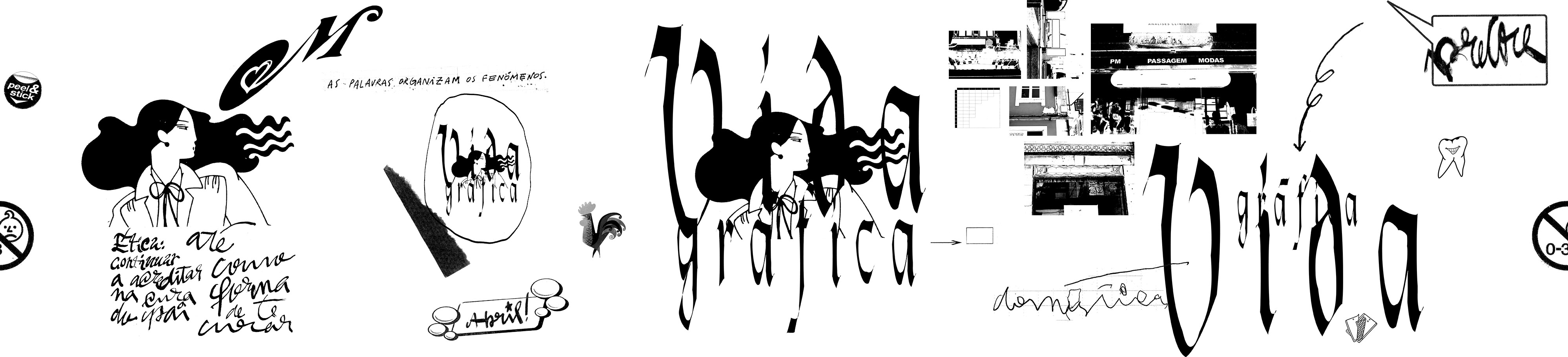
In a time when visual identities have become democratised — first with highly 'customisable' templates and then with algorithm‑driven automation — what does a designer do? Who is the designer, and who can be one?
● Miguelʼs work involves knowing how to blend into creative teams, as has been the case with cultural event production teams and civic participation collectives, and taking on the role of visual communication always with collaborative processes in mind. His understanding of visual identities and other graphic arts work does not detach itself from the subjectivity of artistic creation or the idea of authorship, with the nuance that in this field it is necessarily collective. Each case is different. He does not have a single, absolute idea of legibility when thinking about communication. Depending on the context, he even enjoys challenging it. The reach of his practice has been mostly local and community‑based. He is interested in working on the legitimation and self‑determination of brands, products and collectives. He does not adhere to supposed universalisms that hide assimilationist intentions.
He believes in a one made of vibrant, identity‑driven multiples that intersect. He likes ornaments. «I consider myself an amazed one — I see treasures in everything, especially in the mundane, and therefore I am a collector.» In any case, that is the primary quality of the graphic designer. He does not believe that ʻif the graphic work is done well, you don't even notice itʼ. Visual languages serve to create audiences — that is, to find people and establish bonds. His projects may start with the transcendence of concepts, but he is also the guy who, at the very last minute, will sort out a piece of adhesive tape. Being part of small‑scale projects and working with local institutions gives him flexibility and autonomy, and although it has the drawback of preventing him from specialising, it equips him each year with another half‑dozen techniques and various kinds of resourcefulness.


Miguel is part of the most noble Cooperativa Artística Cabanões Cardoso — no greater honour exists, even in these times of liberaloids, it is a battalion of geniuses of these days, always finding a way to turn things around. Not everyone is a Cardoso, nor do they all come from Cabanões: the cooperative has an accidental name that always reminds us that the meaning is love, and love is home.
Love of Christ and others!!! (he sings in choirs and practises domestic theology with little erudition but of the greatest sophistication — much like Marxism). But despite the boastful bluster, you can count on him; he knows how to do a few things, learns quickly and is always happy to help.

Itʼs a guarantee:
always more useful than costly.
Curation and introductory text by Norberto Castro. Content, project texts, site design and clumsy programming by Miguel R. Cardoso, with the typefaces Times New Roman MT Condensed, MingLiU and Maison. No rights reserved: if there is anything worth copying, go for it!
 Site published in July 2026.
With a giant hug, the size of oneʼs patience, to JDS <3, mommy, Pinoshaite and Deidra, Ti Nita, grandmother São, daddy Julião and grandfather Álvaro (both resting in peace), Gemeans, Primazia and the rest of the Pergulho family. To the comrades from Bloco da Visa and from the Cine Clube. To the very long‑standing friends who followed the first steps of this project, especially Vitinho, Mr Tiggz, Fabito Mitra and Justafá, with many kisses to the families (Neuza! Santi! Maria João! Inês! Duarte!). To Matilde, who got me a whole series of jobs — she was almost an agent. To the friends who made Caldas their home: Marcos, Dantas, Portela, Sousa, Marta, Leonor, Jorginho, and to the teachers Luísa Barreto, Nuno Fragata, Miguel Macedo, Teresa Luzio, Paulo Silva... above all. To Frei Zé Carlos and the Franciscan order of the Tertiaries, and to the new friends from the Amarelo Silvestre theatre group. To the pastry shops of Viseu, especially the one at Praça de Goa, and to the Municipality of Proença‑a‑Nova and its people for the most discreetly incredible county in the country. To...